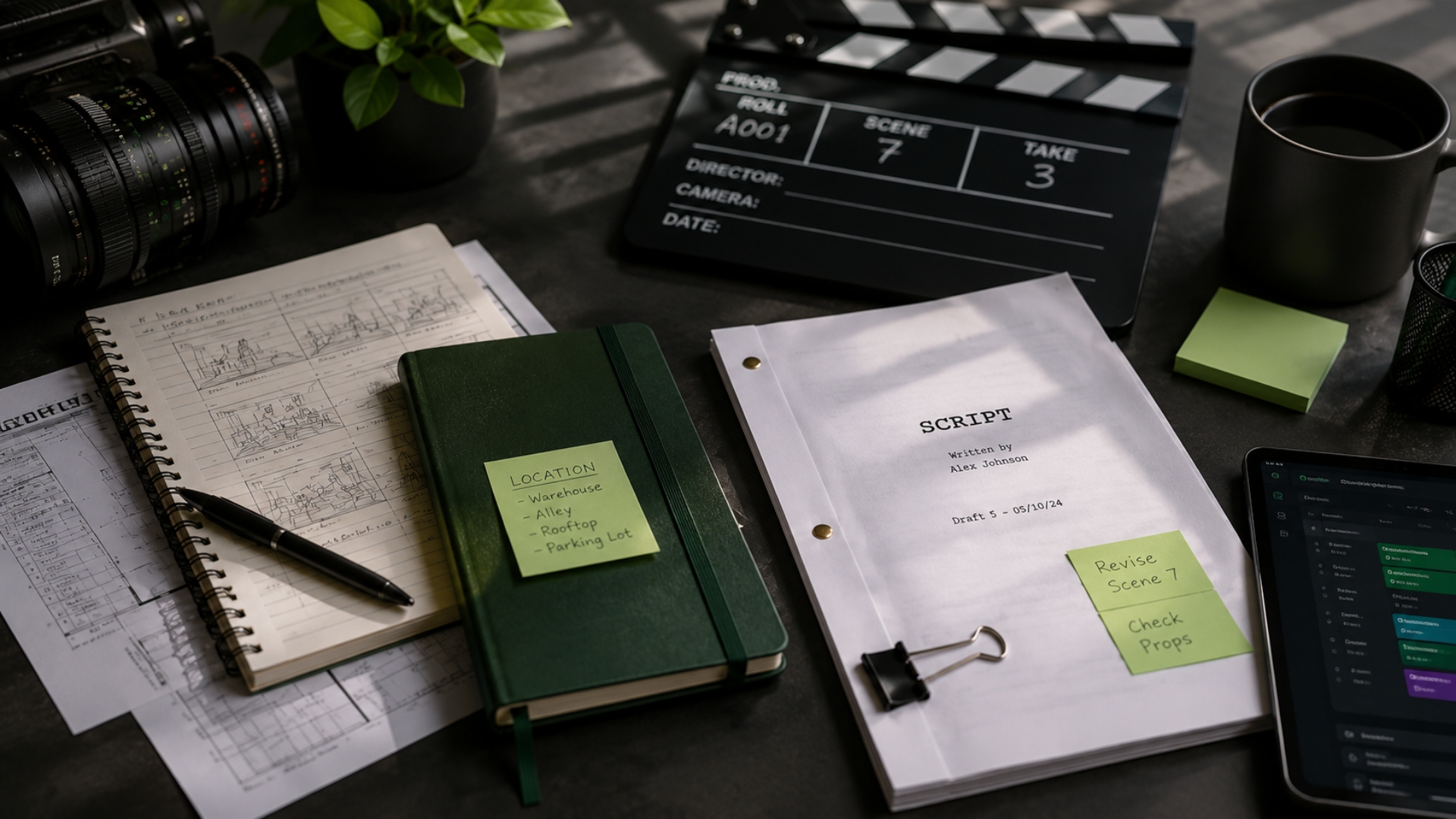
A successful film rarely begins when the camera starts rolling. Long before the first shot, filmmakers are making decisions about the script, cast, locations, schedule, crew, equipment, budget, and dozens of other details that determine how smoothly production will run.
That process is called pre-production.
Whether you’re creating a short film, independent feature, commercial, documentary, or larger production, pre-production turns a creative idea into an actionable plan.
In this guide, we’ll explain what pre-production is, why it matters, and the key steps filmmakers typically complete before arriving on set.
What Is Pre-Production in Film?
Pre-production is the planning stage of filmmaking that takes place after a project has been developed and before principal photography begins.
During pre-production, the screenplay is translated into practical production requirements. The team identifies what needs to be filmed, who and what will be needed for each scene, where filming will happen, and how the production will be scheduled and organized.
Typical pre-production tasks include:
- Finalizing the screenplay
- Breaking down the script
- Creating a budget
- Hiring cast and crew
- Scouting locations
- Planning shots
- Organizing props, wardrobe, and equipment
- Creating a shooting schedule
- Preparing call sheets and production documents
The exact process varies depending on the size and type of production, but the objective remains the same: solve as many logistical and creative problems as possible before filming begins.
Why Is Pre-Production Important?
Production days are expensive.
Actors, crew members, locations, equipment, transportation, catering, permits, and other resources may all be operating on a limited schedule and budget. A problem that takes five minutes to solve during pre-production could potentially cost hours on set.
Good pre-production helps filmmakers:
- Identify production requirements early
- Spot potential logistical problems
- Create realistic shooting schedules
- Coordinate departments
- Manage resources more efficiently
- Reduce unnecessary delays
- Keep creative and production teams aligned
Pre-production isn’t about removing spontaneity from filmmaking. It’s about creating enough structure that the team has room to focus on the creative work when production begins.
The Film Pre-Production Process: Step by Step
There isn’t one universal pre-production workflow. A two-person short film will obviously operate differently from a feature with dozens of crew members.
However, most productions move through the following core stages.
Step 1: Finalize the Screenplay
Pre-production starts with the script.
Before detailed production planning begins, the team needs a screenplay that is stable enough to analyze. Changes can still happen later—and frequently do—but constantly changing scenes during planning can affect almost every department.
For example, adding a new scene could require:
- Another location
- Additional cast
- New costumes
- Extra props
- Different equipment
- More shooting time
The screenplay therefore becomes the foundation for much of the information created during pre-production.
For collaborative projects, it also helps to have a clear system for managing revisions so everyone is working from the correct version.
Step 2: Break Down the Script
Once the screenplay is ready for planning, the production team performs a script breakdown.
A script breakdown involves analyzing every scene and identifying the elements required to film it.
These elements may include:
- Cast members
- Background actors
- Props
- Wardrobe
- Makeup and hair
- Locations
- Vehicles
- Animals
- Special effects
- Visual effects
- Stunts
- Special equipment
- Sound requirements
Imagine a screenplay contains a scene in which three characters drive to a restaurant during a thunderstorm.
A breakdown might immediately reveal requirements for three cast members, a picture vehicle, a restaurant location, rain effects, wet-weather wardrobe continuity, exterior lighting, and potentially additional equipment.
This is why script breakdowns are so important: the screenplay describes the story, while the breakdown reveals what the production actually needs.
Step 3: Establish the Budget
Once the production requirements become clearer, the team can develop a more realistic budget.
Film budgets may include costs for:
- Cast
- Crew
- Equipment
- Locations
- Set construction
- Props
- Wardrobe
- Makeup
- Transportation
- Accommodation
- Catering
- Insurance
- Permits
- Post-production
- Contingencies
Budgeting and script breakdown often influence each other.
If a scene requires resources the production cannot realistically afford, filmmakers may need to rethink how the scene is executed—or revise the screenplay itself.
This makes pre-production an iterative process rather than a simple checklist.
Step 4: Assemble the Cast and Crew
The production then needs the people who will bring the project to life.
Depending on the scale of the film, key crew positions may include:
- Director
- Producer
- Assistant director
- Director of photography
- Production designer
- Sound team
- Costume designer
- Hair and makeup
- Gaffer
- Grip team
- Script supervisor
- Production coordinator
- Location manager
Casting also takes place during this period through auditions, callbacks, negotiations, and scheduling.
Availability matters enormously.
If a key actor is only available on certain dates, that constraint may influence the entire shooting schedule.
Step 5: Scout and Secure Locations
Location scouting involves finding environments that meet both the creative and practical requirements of the screenplay.
A location may look perfect visually but still be difficult to film in.
Filmmakers need to consider factors such as:
- Space for cast and crew
- Power availability
- Natural and artificial lighting
- Ambient noise
- Parking
- Equipment access
- Bathrooms
- Holding areas
- Weather
- Accessibility
- Permits and restrictions
- Available shooting hours
Locations should therefore be evaluated as production environments, not just visual backdrops.
Once locations are selected, permissions, agreements, insurance requirements, and permits should be handled before the shoot.
Step 6: Plan the Visual Approach
While logistical planning progresses, the director and key creative departments determine how the film will look and feel.
This process can involve:
- Shot lists
- Storyboards
- Floor plans
- Lighting references
- Camera tests
- Lens choices
- Production design references
- Costume concepts
- Lookbooks
- Previsualization
A shot list translates scenes into the specific shots the team intends to capture.
For complicated sequences, storyboards and previsualization can help departments understand camera positions, blocking, effects, and equipment requirements before arriving on set.
Step 7: Organize Props, Wardrobe, Sets, and Equipment
The script breakdown now becomes particularly useful.
Every identified production element needs to be sourced, created, rented, purchased, tested, or otherwise prepared.
Departments can use the breakdown to determine what is needed for each scene.
Continuity is also important.
If a character wears the same jacket across scenes filmed several days apart, the production needs to know exactly which scenes require that wardrobe item.
The same applies to props, makeup, vehicles, set dressing, and other visual elements.
Connecting these elements directly to scenes makes them much easier to track.
Step 8: Create the Shooting Schedule
Films are rarely shot in screenplay order.
Instead, scenes are grouped based on practical considerations such as:
- Actor availability
- Location availability
- Day versus night scenes
- Interior versus exterior scenes
- Equipment requirements
- Setup complexity
- Travel time
- Production efficiency
For example, if scenes 4, 18, and 37 all take place in the same apartment, it may make sense to shoot them consecutively even though they appear at different points in the story.
The production team therefore turns the screenplay and its breakdown into a shooting schedule.
A strong schedule balances efficiency with realism. Packing too many scenes into a single day can create delays, overtime, rushed performances, or unfinished coverage.
Step 9: Hold Technical Scouts, Rehearsals, and Tests
As production approaches, departments begin validating the plan.
A technical scout allows key crew members to visit locations together and determine exactly how filming will work.
Questions might include:
- Where will the camera go?
- Where will lights receive power?
- Where can equipment be staged?
- How will the crew move between setups?
- Where will actors wait?
- Are there sound problems?
- Are there safety concerns?
Productions may also schedule rehearsals, wardrobe fittings, makeup tests, camera tests, stunt rehearsals, or equipment tests depending on the needs of the film.
The goal is to discover problems while there is still time to solve them.
Step 10: Prepare Production Documents
As filming gets closer, the production team consolidates information into documents the crew can use.
These may include:
- Shooting schedules
- Call sheets
- Crew lists
- Cast lists
- Contact sheets
- Location information
- Script sides
- Equipment lists
- Breakdown reports
- Safety information
- Maps and parking instructions
Information should be accurate and easy to access.
A production becomes much harder to manage when critical details are scattered across different spreadsheets, PDFs, email threads, messages, and software tools.
Step 11: Confirm Everything Before the Shoot
The final stage of pre-production is confirmation.
Before principal photography begins, the production team should verify that the major pieces are actually ready.
That means confirming things such as:
- Cast availability
- Crew call times
- Locations
- Permits
- Equipment
- Transportation
- Props
- Wardrobe
- Catering
- Production documents
- Weather considerations
- Emergency and safety procedures
This final review gives the production an opportunity to catch missing details before they become problems on set.
How Long Does Film Pre-Production Take?
There is no standard length for film pre-production.
A small short film might require several days or weeks of preparation, while an independent feature may spend weeks or months in pre-production. Large productions can require considerably longer.
The timeline depends on factors including:
- Script complexity
- Number of locations
- Size of the cast
- Size of the crew
- Budget
- Stunts and special effects
- Set construction
- Equipment requirements
- Travel
- Permits
- Actor availability
The better question is not simply, “How long should pre-production take?”
It’s:
Has the production solved enough problems to realistically execute the plan?
Who Is Involved in Film Pre-Production?
Pre-production is collaborative.
The producer typically oversees the broader production, while the director leads the creative vision. Assistant directors, production managers, coordinators, department heads, and other crew members turn that vision into a workable plan.
Different departments join the process at different stages depending on the scale of the project.
Even on a small independent film, however, someone needs to take responsibility for the major pre-production functions: breaking down the screenplay, organizing resources, coordinating people, and scheduling the shoot.
What Happens After Pre-Production?
Once pre-production is sufficiently complete, the project moves into production, when principal photography takes place.
The filmmaking process is commonly divided into:
Development → Pre-production → Production → Post-production → Distribution
The work completed during pre-production directly affects the production stage.
A clear script breakdown helps departments know what they need. A realistic schedule tells everyone where and when scenes will be filmed. Organized production information allows the crew to respond quickly when circumstances change.
Because circumstances will change.
The purpose of pre-production isn’t to predict everything perfectly. It’s to give the team a strong enough plan to adapt when reality inevitably differs from that plan.
How Software Can Simplify Film Pre-Production
Traditional film planning often involves moving information between separate documents and tools.
The screenplay lives in one application. The breakdown exists somewhere else. Production elements are stored in spreadsheets. Scheduling happens in another system. Notes arrive through messages and email.
Every handoff creates another opportunity for information to become outdated or disconnected.
Modern film production platforms can instead connect these workflows.
Cinelaya brings screenwriting and pre-production together in one collaborative workspace, helping filmmakers move from the screenplay into breakdown and production planning without rebuilding their project across disconnected tools.
With Cinelaya, teams can develop their screenplay, organize production information, collaborate, and move toward the shoot from a shared source of truth.
For independent filmmakers and production teams in particular, that means less time managing scattered production information, and more time actually preparing the film.
Ready to turn your screenplay into a production plan? Explore Cinelaya and start organizing your next film from script to shoot.
Pre-production is where a screenplay stops being only a story on the page and starts becoming a film that can actually be made.
The more organized that transition is, the easier it becomes for everyone, from the director and producer to individual departments, to understand what needs to happen next.
Cinelaya is built to make that transition simpler.
Write and develop your screenplay, break it down for production, organize your project, collaborate with your team, and keep the filmmaking process connected in one workspace.
Start your next production with Cinelaya.